
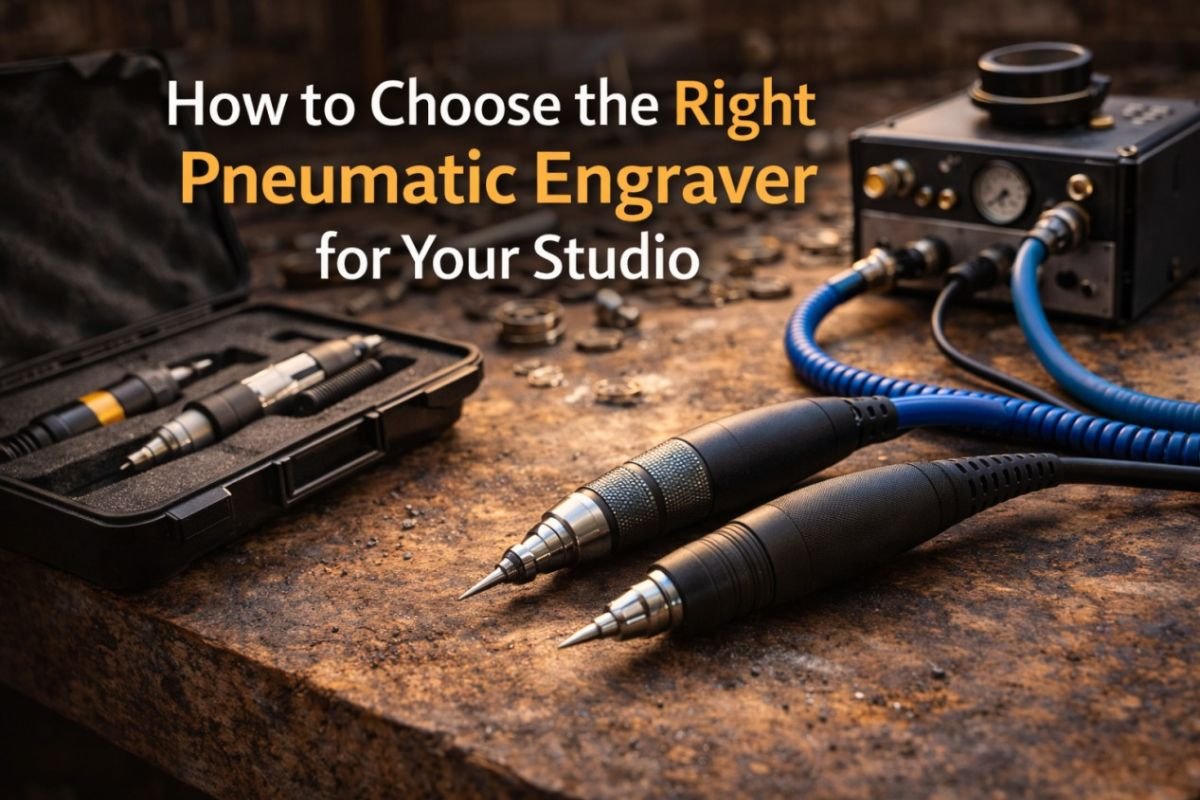
At some point in an engraver’s journey, the question becomes unavoidable. Not whether to upgrade tools, but how to choose the right system.
The market offers countless options. Different sizes, power levels, configurations, and price ranges. For beginners, it can feel overwhelming. For professionals, the decision carries long-term consequences. A pneumatic engraver is not a small accessory—it becomes the center of your workflow.
Choosing correctly means building a foundation that supports years of craftsmanship. Choosing poorly means constant adjustment, frustration, and eventual replacement.
Understanding what truly matters simplifies the process.
Start With Your Working Style
The first consideration is not technical specifications. It is how you actually work.
Do you engrave daily or occasionally? Are you producing custom jewelry pieces or larger metal components? Do you prioritize portability or a fixed bench setup?
Your workflow determines your needs. A compact system may suit a home studio, while a more robust integrated unit may better support a growing professional operation. The right choice aligns with your daily rhythm, not just your ambitions.
Power and Control Must Be Balanced
Many people assume that more power automatically means better performance. In engraving, that is rarely true.
Too much force can make delicate work difficult to control. Too little force limits efficiency on harder metals. A well-designed pneumatic system provides adjustable, consistent impact that matches the material being engraved.
When evaluating systems, look for stability rather than raw strength. Consistent performance across different pressure settings matters more than maximum output.
Consider Ergonomics Carefully
The handpiece becomes an extension of your hand. If it feels unbalanced or uncomfortable, fatigue will accumulate quickly.
Weight distribution, grip texture, and vibration control all influence long-term comfort. Even small differences become significant during extended sessions.
High-quality systems are designed with ergonomic balance in mind. The goal is to reduce strain while maintaining precise control. Comfort is not a luxury—it directly affects productivity and consistency.
Integrated Systems vs Separate Components
Another decision involves configuration. Some engravers prefer separate systems for engraving, polishing, and micro motor work. Others prefer integrated units that combine multiple functions into a single control base.
Integrated systems simplify workflow and reduce workspace clutter. They are especially practical for smaller studios where bench space is limited.
Katway’s pneumatic engraver collection includes options that balance compact design with professional performance, making them suitable for both independent makers and growing workshops.
Choosing between integrated and modular setups depends on how you prefer to organize your space.
Think Long-Term, Not Short-Term
It is tempting to choose based on current needs alone. However, engraving skills evolve. Techniques expand. Projects become more ambitious.
A system that feels sufficient today may become limiting in two years. Investing in equipment that allows room for growth prevents unnecessary upgrades later.
Durability also plays a major role. Professional-grade systems maintain consistent performance over extended use, ensuring that your investment supports your craft for years rather than months.
Noise and Workspace Environment
Studio environment influences daily comfort. Pneumatic systems require compressed air, and sound levels vary depending on design.
Modern compact systems are engineered to operate smoothly without excessive noise. This matters for home studios and shared spaces where comfort affects concentration.
Choosing a well-designed system improves not only work quality, but the overall atmosphere of your studio.
Maintenance and Reliability
Reliable tools require minimal interruption. Before choosing a system, consider how easily it can be maintained. Durable components and stable construction reduce downtime.
Frequent adjustments or inconsistent performance disrupt workflow. Stability should be a priority.
A well-built pneumatic engraver maintains consistent output without constant recalibration. This reliability protects both productivity and confidence.
Learning Curve Considerations
For beginners, the learning curve matters. A system that provides stable impact and intuitive control makes skill development smoother.
For experienced engravers, adaptability matters more. The ability to adjust pressure and refine technique allows continued growth.
Choosing a system that accommodates both stability and flexibility ensures that your tools evolve alongside your skill level.
Budget as Investment, Not Expense
Price is always a consideration, but context matters. Lower-cost systems may appear attractive initially, yet inconsistent performance often leads to replacement.
Professional-grade tools represent long-term investment. When measured over years of use, reliability and efficiency often outweigh initial savings.
A pneumatic engraver is central to your workflow. It should be selected with the same care as any major professional decision.
Matching the Tool to Your Ambition
Ultimately, the right system aligns with your goals. If engraving is an occasional hobby, a simpler system may suffice. If engraving is central to your profession, investing in a reliable, stable pneumatic system is essential.
Your ambition determines the standard you require. The right tool ensures that standard can be met consistently.
Final Thoughts:
Selecting a pneumatic engraver is not about finding the most powerful or the most affordable option. It is about choosing stability, comfort, and long-term performance.
The right system becomes part of your creative process. It supports precision, protects your hands, and allows your craft to evolve without limitation.
When tools align with your working style and long-term goals, engraving becomes not only more efficient, but more enjoyable. And that alignment is what ultimately defines a successful studio.