
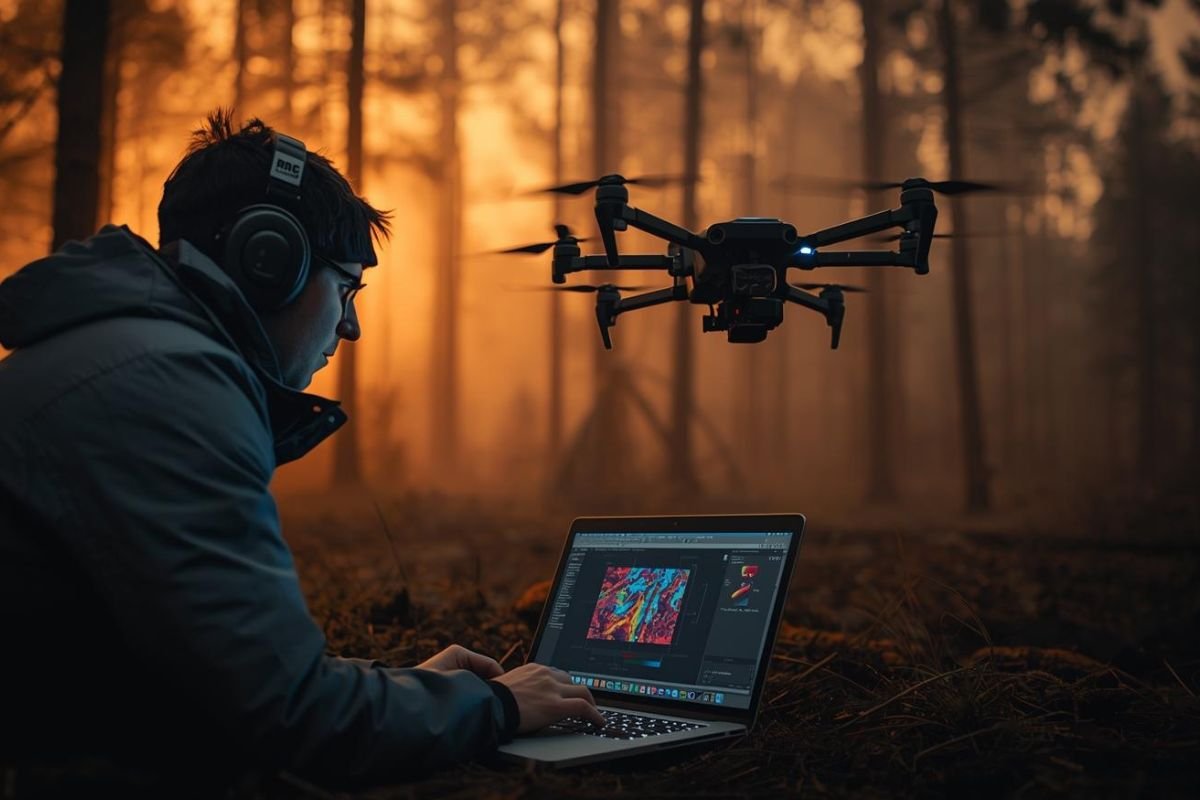
Tyler Harp CMU is a rising robotics researcher making significant contributions to autonomous UAV systems. At Carnegie Mellon University, he focuses on advancing drone perception, wildfire response, and real-world robotics applications.
This article explores Tyler Harp CMU’s academic journey, research accomplishments, industry experience, and personal pursuits, offering a detailed view for students, researchers, and technology enthusiasts interested in robotics innovation.
Early Life and Academic Foundations
Background and Early Interests
From a young age, Tyler Harp CMU demonstrated a fascination with mechanical systems and robotics.
His curiosity about autonomous machines and complex engineering problems led him to pursue higher education in fields blending technology and innovation.
Undergraduate Education at CMU
Tyler Harp CMU earned a Bachelor of Science in Mechanical Engineering with a Robotics minor at Carnegie Mellon University.
His coursework emphasized control theory, computer vision, and autonomous systems, laying a strong foundation for advanced robotics research. He also engaged in hands-on projects that combined hardware and software skills.
Graduate Studies
Continuing at CMU, enrolled in the Master of Science in Robotics (MSR) program in the School of Computer Science.
Here, he joined the AirLab (Autonomous Systems Lab), where he honed skills in UAV navigation, mapping, and sensor integration under Professor Sebastian Scherer.
Research Experience and Focus
CMU AirLab (Autonomous Systems Lab)
The AirLab specializes in developing UAV and ground robot systems for complex environments. contributes to this lab’s mission, focusing on perception, mapping, and autonomous navigation in challenging scenarios like wildfire zones and GPS-denied environments.
Key Research Areas
Tyler Harp CMU’s main research areas include:
- 3D Mapping and SLAM: Enabling drones to build accurate spatial representations in real time.
- Sensor Fusion: Integrating LiDAR, thermal cameras, and RGB sensors for resilient perception.
- Autonomous Navigation: Allowing UAVs to plan safe paths in smoke-filled or low-visibility conditions.
Wildfire and Disaster Robotics Projects
One of the primary research focuses is on deploying autonomous drones in wildfire and disaster environments.
These UAVs must maintain navigation and perception despite smoke, heat, and shifting terrain, making this work both challenging and high-impact.
Major Contributions and Technical Work
FIReStereo Dataset
Tyler Harp CMU co-developed the FIReStereo dataset, a large-scale stereo-thermal imaging dataset designed for UAVs operating in visually degraded conditions. Features include:
| Feature | Details |
| Image Pairs | 200,000 synchronized stereo-thermal images |
| Ground Truth | LiDAR-based depth measurements |
| Environments | Urban, forested, night, day, rain, smoke |
This dataset allows researchers to train UAV perception algorithms for extreme real-world conditions.
Master’s Thesis
Tyler Harp CMU completed his thesis, “Vision-Based Multi-Wire Detection and Tracking for UAV Wire Approach”, which addresses UAV safety by detecting thin wires and powerlines.
The thesis introduces a real-time, camera-only algorithm that integrates geometric reasoning and filtering techniques for low-altitude UAV navigation.
Other Publications and Technical Reports
Tyler Harp CMU has co-authored IEEE publications and CMU technical reports. His work strengthens the field of autonomous UAV perception and provides valuable resources for researchers and engineers.
Tools, Technologies, and Techniques
Tyler Harp CMU leverages:
- Thermal and RGB cameras
- LiDAR sensors for ground truth
- SLAM and mapping algorithms
- ROS for UAV software integration
This combination ensures drones can navigate safely in smoke-filled forests and other degraded environments.
Real-World Applications
Wildfire Monitoring
Tyler Harp CMU’s research enables UAVs to detect fire spread, hotspots, and terrain changes in real time. This approach reduces human risk while improving situational awareness for firefighters.
Disaster Response
Autonomous drones developed with Tyler Harp CMU’s algorithms can operate in hazardous zones, collecting critical data, assisting in search-and-rescue, and mapping damaged areas efficiently.
Infrastructure Inspection
Using multi-wire detection algorithms, Tyler Harp CMU’s UAVs can safely inspect bridges, powerlines, and industrial structures, minimizing risks for human inspectors.
Certifications and Professional Experience
FAA Certification
Tyler Harp CMU holds a FAA Part 107 drone pilot license, allowing him to conduct research flights legally and test UAV algorithms in real-world conditions.
Industry Internship
He gained industry experience as a Robotics Software Engineering Intern at Symbotic, working on autonomy software and industrial UAV solutions.
Collaborative Research
Within AirLab, Tyler Harp, CMU, has worked closely with peers and mentors on datasets, perception algorithms, and resilience testing, emphasizing teamwork in research innovation.
Athletics and Personal Interests
Student-Athlete Experience
Tyler Harp, CMU, also excels in athletics. As a CMU Men’s Soccer team member, he develops discipline, strategic thinking, and teamwork skills, which complement his research abilities.
Hobbies and Lifestyle
He enjoys skiing, exploring new hobbies, and mechanical projects, demonstrating a balanced lifestyle that supports creativity and productivity.
Skills and Competencies
Technical Skills
- SLAM and 3D mapping
- Multi-sensor UAV perception
- Real-time obstacle detection
- Mechanical system integration
Soft Skills
- Collaboration and leadership
- Strategic problem-solving
- Time management under pressure
Impact and Future Outlook
Contributions to Robotics
Tyler Harp CMU’s work enhances autonomous UAV reliability in challenging environments. His datasets, algorithms, and field tests push the boundaries of safe aerial robotics.
Career Trajectory
He is well-positioned for research, tech innovation, or industry roles in autonomous systems, UAV perception, and disaster robotics.
Broader Implications
The work of Tyler Harp, CMU, impacts public safety, environmental monitoring, and infrastructure management, showing how robotics research can solve real-world challenges.
Conclusion
Tyler Harp, CMU, represents a new generation of robotics researchers. By combining advanced perception algorithms, datasets, and real-world testing, he strengthens UAV safety, wildfire monitoring, and disaster response.
His academic and professional journey at Carnegie Mellon University, alongside athletic and personal pursuits, highlights the breadth and depth of his contributions.
For researchers, students, and technology enthusiasts, Tyler Harp CMU exemplifies the convergence of innovation, practical impact, and interdisciplinary excellence.
FAQ’s
Who is Tyler Harp CMU?
Tyler Harp, CMU, is a robotics researcher and graduate student at Carnegie Mellon University specializing in UAV perception, autonomous navigation, and disaster robotics.
What does Tyler Harp CMU study?
He studies autonomous UAV systems, SLAM, and sensor fusion in the Master of Science in Robotics program at CMU.
What research projects is he known for?
Tyler Harp CMU is known for the FIReStereo dataset and multi-wire detection algorithms for UAVs operating in wildfire and hazardous conditions.
Has Tyler Harp CMU participated in athletics?
Yes, he is an active CMU Men’s Soccer team member, balancing sports with research responsibilities.
What certifications does Tyler Harp, CMU, hold?
He holds the FAA Part 107 drone pilot license, allowing him to legally operate research UAVs in field tests.
How can students follow Tyler Harp’s CMU work?
Students can follow his publications via CMU AirLab, IEEE journals, and robotics conferences that feature UAV research.